
Ubud is often described as the cultural heart of Bali, but that description only begins to explain what makes the town so interesting. Beyond its famous rice fields, cafés, yoga studios, art galleries, and boutique hotels, Ubud is surrounded by temples, traditional villages, ancient archaeological sites, and living cultural traditions that continue to shape everyday life.
For first-time visitors, the best way to experience Ubud is not simply to move from one tourist attraction to another. Instead, take time to understand the connection between Balinese Hinduism, traditional architecture, art, food, nature, and community life.
From visiting historic temples and watching traditional performances to exploring local markets and enjoying Balinese cuisine, Ubud offers many opportunities to experience a different side of Bali.
Ubud's identity has been shaped by art, spirituality, agriculture, and royal traditions for generations.
The area is home to traditional compounds, temples, rice terraces, art communities, and cultural institutions. Places such as Peliatan and surrounding villages retain strong connections with traditional Balinese arts, while the central area of Ubud has developed into an international destination for travelers interested in wellness, food, culture, and creative experiences.
This combination makes Ubud particularly interesting for travelers who want more than beaches and nightlife.
The cultural landscape is also still alive. Temples are not simply historical monuments or photography locations. They remain places of worship where Balinese Hindus pray, make offerings, and conduct religious ceremonies.
That distinction is important when exploring Ubud.
A temple visit should therefore be approached as a cultural experience rather than simply another sightseeing stop.
One of the most rewarding ways to understand Ubud is through its temples.
A pura, the Balinese term commonly used for a Hindu temple, can serve different religious and community functions. Some temples are associated with particular villages, royal families, water sources, or specific deities and ceremonies.
For travelers, this means that visiting several temples can reveal different aspects of Balinese culture.
Some temples are located in the center of Ubud, while others are situated among rice fields, forests, river valleys, and traditional villages outside the town.
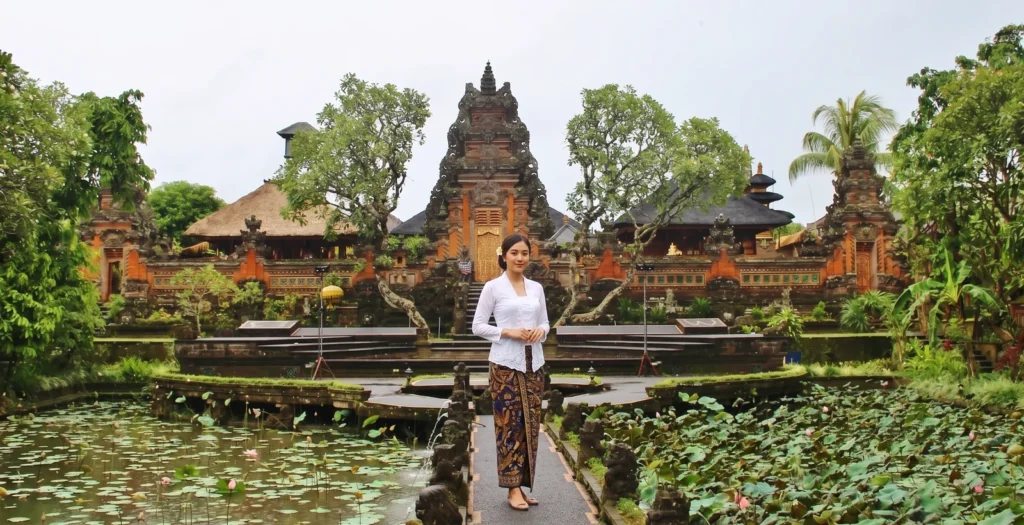
Located in central Ubud, Pura Saraswati is one of the most recognizable temples in the area.
The temple is associated with Saraswati, the Hindu goddess connected with knowledge, learning, literature, and the arts. Its lotus pond and traditional Balinese architectural details make it one of the most visually distinctive cultural sites in central Ubud.
Its location also makes it convenient to combine with other experiences in the town, including Ubud Palace, Ubud Art Market, cafés, restaurants, and traditional performances.
For photographers and travelers interested in Balinese architecture, it provides a good introduction to the visual language of Balinese temples.
East of central Ubud lies Goa Gajah, commonly known as the Elephant Cave.
Despite its name, Goa Gajah is not simply a cave attraction. It is an important archaeological and religious site featuring ancient stone carvings, bathing pools, courtyards, and sacred areas.
Indonesia's official tourism authority describes Goa Gajah as an archaeological site containing both Hindu and Buddhist influences, with origins associated with the ancient period of Bali.
The site demonstrates why Ubud's cultural attractions cannot always be separated neatly into categories such as “temple,” “historical site,” or “tourist attraction.” Many locations combine religious, archaeological, architectural, and natural elements.
Further north, near Tampaksiring, is Tirta Empul Temple, one of Bali's best-known water temples.
Tirta Empul is famous for its sacred spring water and the melukat purification ritual. The complex remains an active religious site, meaning visitors should approach the area with appropriate respect.
Indonesia Travel notes that Tirta Empul is located in Manukaya Village, Tampaksiring, Gianyar, and is particularly known for its sacred springs and spiritual significance.
For visitors who want to understand the spiritual dimension of Bali, Tirta Empul can be considerably more meaningful than simply photographing the temple architecture.
However, travelers should remember that melukat is a religious ritual rather than a tourism performance. Anyone participating should follow the instructions of temple staff or local guides and respect the people who are there for religious purposes.
Another fascinating cultural site near Ubud is the Gunung Kawi Temple complex.
Located in a lush river valley near Tampaksiring, Gunung Kawi is known for monumental shrines carved directly into rock cliffs. The site combines archaeology, landscape, architecture, and spirituality in a way that is distinctly Balinese.
The complex is reached by descending a long series of steps into the valley, making comfortable footwear particularly useful.
The setting is part of the experience. Rather than simply viewing a monument, visitors move through a landscape of greenery, stone, water, and ancient structures.
Travelers can certainly visit Ubud's temples independently. However, understanding what you are looking at can be difficult without some cultural context.
A temple tour in Ubud can provide an opportunity to visit several sacred and historical sites while learning about their roles in Balinese society.
This can be particularly useful for first-time visitors who are unfamiliar with concepts such as pura, canang sari, melukat, temple ceremonies, and Balinese Hindu traditions.
The biggest advantage of having a knowledgeable local guide is not simply transportation between locations. It is the interpretation.
A guide can explain why a temple has a particular layout, what certain architectural elements represent, why offerings are placed in specific locations, and how religious ceremonies influence everyday life.
That additional context can transform a quick sightseeing stop into a much more meaningful cultural experience.
Because Balinese temples are active places of worship, visitors should follow local customs.
The basic principles are simple:
– Dress modestly when entering a temple.
– Wear a sarong and sash where required.
– Keep your voice low.
– Do not interrupt people who are praying.
– Do not enter areas restricted to worshippers.
– Avoid stepping on canang sari, the small daily offerings placed around homes, shops, streets, and temples.
– Ask permission before photographing people during ceremonies.
– Follow instructions from temple staff or local guides.
– Do not treat religious ceremonies as staged performances.
Indonesia's official tourism guidance similarly emphasizes respecting temple rules, keeping noise down, avoiding disruption of rituals, and wearing appropriate clothing.
The principle is straightforward: observe respectfully rather than behave like you are visiting an ordinary tourist attraction.
Another reason Ubud's temples are so interesting is their relationship with the surrounding landscape.
Balinese cultural traditions do not treat temples as isolated buildings. Many sacred sites are connected with rivers, springs, forests, mountains, agricultural land, and villages.
This can be seen particularly clearly around sites such as Tirta Empul and Gunung Kawi.
The Pakerisan River valley, for example, connects several important cultural sites in the Tampaksiring area. Gunung Kawi is situated within the valley landscape, while Tirta Empul lies nearby.
This relationship between spirituality and nature is one of the reasons exploring Ubud can feel different from visiting a conventional historical city.
You are often moving through a cultural landscape rather than simply visiting individual monuments.
Food is another essential part of understanding Ubud.
The town has developed a reputation for cafés, vegetarian restaurants, wellness menus, international cuisine, and specialty coffee. However, visitors should also make time to explore traditional Balinese dishes.
Depending on where you eat, you may encounter dishes such as:
– Nasi campur Bali
– Ayam betutu
– Lawar
– Sate lilit
– Pepes ikan
– Babi guling
– Balinese sambal
– Traditional sweets and snacks
One of the best approaches is to combine cultural sightseeing with food exploration.
For example, travelers might spend the morning exploring temples and traditional sites, enjoy lunch at a local restaurant, then continue exploring Ubud's markets, galleries, or surrounding villages in the afternoon.
This creates a more complete understanding of the destination because food is not separate from culture. It is part of it.
Another destination worth including in a cultural itinerary is Sacred Monkey Forest Sanctuary.
Although many visitors come primarily to see the long-tailed macaques, the forest also contains important temples, including Pura Dalem Agung Padangtegal.
Indonesia Travel describes the Monkey Forest as both a nature conservation area and a sacred temple complex, with approximately 27 hectares of forest and several temples within the site.
This is another example of how nature and spirituality overlap in Ubud.
Visitors should also remember that the monkeys are wild animals. Avoid feeding them or carrying food openly, and follow the site's safety instructions.
One of the easiest ways to experience Ubud is to create a balanced itinerary rather than trying to visit every attraction.
A sample cultural day could look like this:
Start early with a temple or cultural site before the busiest part of the day.
Depending on your interests, this could include Pura Saraswati, Goa Gajah, or a combination of temples around the Ubud and Tampaksiring areas.
Morning is also generally more comfortable for walking and outdoor sightseeing.
After exploring cultural sites, take a break for lunch.
This is an opportunity to try traditional Balinese food rather than relying exclusively on international restaurants.
Spend the afternoon exploring Ubud's galleries, traditional markets, craft workshops, or surrounding villages.
The central Ubud area is particularly convenient for travelers who want to combine cultural attractions with shopping and dining.
Finish the day with a Balinese dance performance, cultural show, or dinner featuring local dishes.
The result is an itinerary that combines religion, history, food, art, and everyday life rather than focusing on one type of attraction.
For outdoor cultural sightseeing, morning is generally a comfortable choice.
Starting earlier can help visitors avoid the strongest midday heat and, depending on the destination, encounter a quieter atmosphere.
However, there is no single “best” time for every temple.
Religious ceremonies follow the Balinese calendar and local temple schedules, so visitors may encounter ceremonies or special events during their trip. These occasions can provide valuable cultural insight, but tourists should observe from an appropriate distance and follow local instructions.
It is also worth checking current opening information, entrance requirements, and local rules before visiting because practical conditions can change.
Visitors should dress respectfully when entering a Balinese temple.
As a general rule, shoulders and knees should be covered, and visitors may need to wear a sarong and sash.
At many tourist-accessible temples, appropriate clothing can be rented or provided at the entrance. Indonesia Travel also recommends modest clothing and the use of a sarong and sash when visiting sacred sites.
Women who are menstruating may also be subject to restrictions at some sacred sites according to local religious customs. When in doubt, ask temple staff or a local guide rather than making assumptions.
Absolutely.
Ubud is particularly suitable for travelers who want to combine cultural exploration with food, nature, art, and wellness.
Its appeal comes from the variety of experiences available within a relatively compact region. Visitors can explore ancient archaeological sites in the morning, eat traditional Balinese food at lunch, walk through rice fields in the afternoon, and attend a traditional performance in the evening.
More importantly, Ubud offers opportunities to see Balinese culture as something that is still practiced rather than something preserved solely for tourists.
That is what makes exploring the area particularly rewarding.
Ubud is best known for its arts, traditional Balinese culture, temples, rice fields, wellness experiences, galleries, food scene, and surrounding natural landscapes.
Two to three days is a good starting point for first-time visitors. This allows enough time to explore cultural attractions, temples, food spots, nature, and the central town without rushing.
Travelers interested primarily in cultural and spiritual experiences may want to stay longer because several important sites are located outside central Ubud.
Yes, many temples and cultural sites around Ubud are accessible to visitors. However, they remain sacred places, so tourists must follow dress codes, entrance rules, and local customs.
Tirta Empul is one of the best-known spiritual destinations near Ubud because of its sacred spring and association with the melukat purification ritual. It is located in Tampaksiring, north of central Ubud.
Goa Gajah is best understood as an archaeological and religious complex rather than simply a conventional temple. The site contains an ancient cave, carvings, bathing structures, and sacred areas, with both Hindu and Buddhist influences.
A guide is not essential for every visitor, but it can significantly improve the experience when exploring several temples or religious sites. The main benefit is gaining cultural and historical context that may not be obvious from the architecture alone.
Ubud is easy to visit but more difficult to truly understand.
The cafés, restaurants, rice terraces, spas, and Instagram-famous locations are only one part of the destination. The deeper experience comes from understanding how temples, family compounds, art, food, nature, and religious traditions are connected.
For travelers interested in culture, a thoughtful itinerary should therefore include more than a checklist of attractions.
Visit a temple, but learn why it matters.
Try local food, but understand the traditions behind it.
Walk through a village, but respect the people who live there.
Watch a ceremony, but remember that it is a religious event rather than a tourist show.
That approach allows visitors to experience Ubud with greater appreciation and helps preserve the cultural character that makes this part of Bali so special.
Ultimately, the best Ubud experience is not necessarily about seeing the most places. It is about understanding more of the places you visit